Kamakhya Temple
The foremost Shakti Pitha and India's great tantric goddess shrine
Rising over Guwahati on Nilachal Hill, Kamakhya is one of the most important centres of Shakti and Tantra worship in the world, and the foremost of the 51 Shakti Pithas. Unlike almost any other major Hindu temple, the sanctum holds no image of a deity. Instead, devotees worship a natural cleft in the bedrock, kept moist by an underground spring, revered as the yoni, or creative source, of the goddess Kamakhya, the mother.
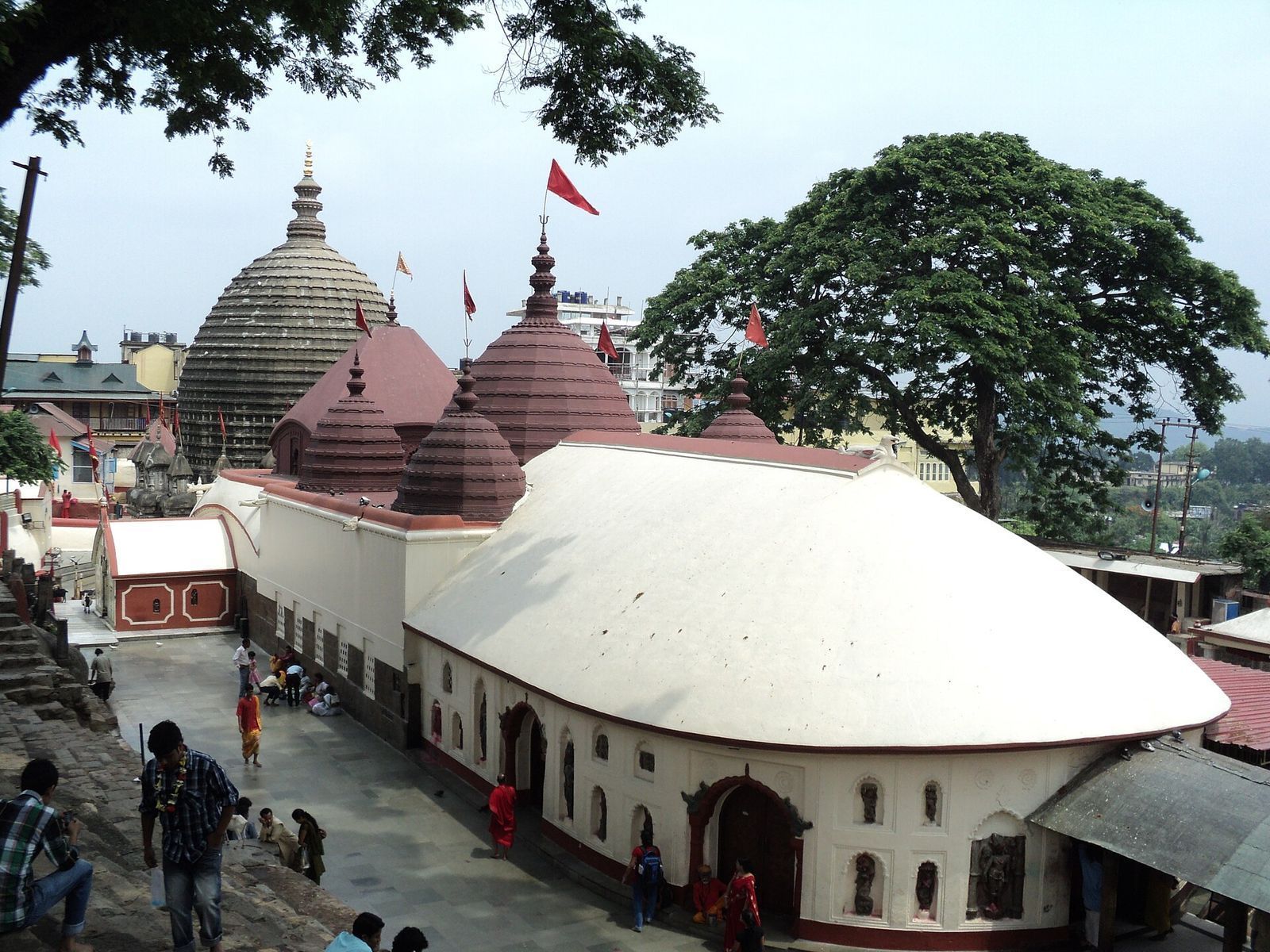
The temple you see today, with its distinctive beehive-shaped shikhara and hemispherical dome, was rebuilt in 1565 by the Koch king Naranarayan after an earlier structure was destroyed; it blends the indigenous Nilachala style with Mughal-era elements. Below the main shrine lie cave chambers where the actual worship takes place, reached down worn stone steps, always crowded, always charged with a sense of the ancient.
The temple's most extraordinary event is the Ambubachi Mela in June, when the goddess is believed to undergo her annual menstruation. The temple closes for three days, and on reopening, one of the largest congregations of tantric practitioners, sadhus and pilgrims in eastern India gathers here, drawing lakhs of visitors from across the country and beyond.
What to see & do
- The natural yoni-shaped rock in the underground sanctum, the true object of worship
- The bee-hive shikhara and the sculpted panels on the outer walls
- The cluster of ten Mahavidya temples on the same hill (Tara, Bhairavi, Chinnamasta and others)
- Sunset views over the Brahmaputra and Guwahati from the hilltop
Getting to Kamakhya Temple
| How to reach | About 8 km from Guwahati centre and 20 km from the airport; taxis and shared autos run up the hill road. |
| Best time | October to April. For the Ambubachi Mela, come in mid-to-late June, but expect huge crowds. |
| Timings | Roughly 5:30 am to 10 pm, with a midday break; the sanctum queue is long — a paid fast-track darshan is usually available. |
| Entry | Free; fast-track and puja tickets are paid. Leather items are often not allowed inside. |
| Good to know | Go early morning to beat both the heat and the crowds. Dress modestly. Animal sacrifice is still practised here — the eastern side of the complex may not suit everyone. |
More to explore
Tawang Monastery
Tawang
India's largest monastery, and the birthplace of the 6th Dalai Lama.
Tripura Sundari Temple
Udaipur
One of India's 51 Shakti Pithas, the guardian deity of the Tripura kings.
Rumtek Monastery
near Gangtok
The grand seat-in-exile of the Karmapa and the Kagyu lineage.